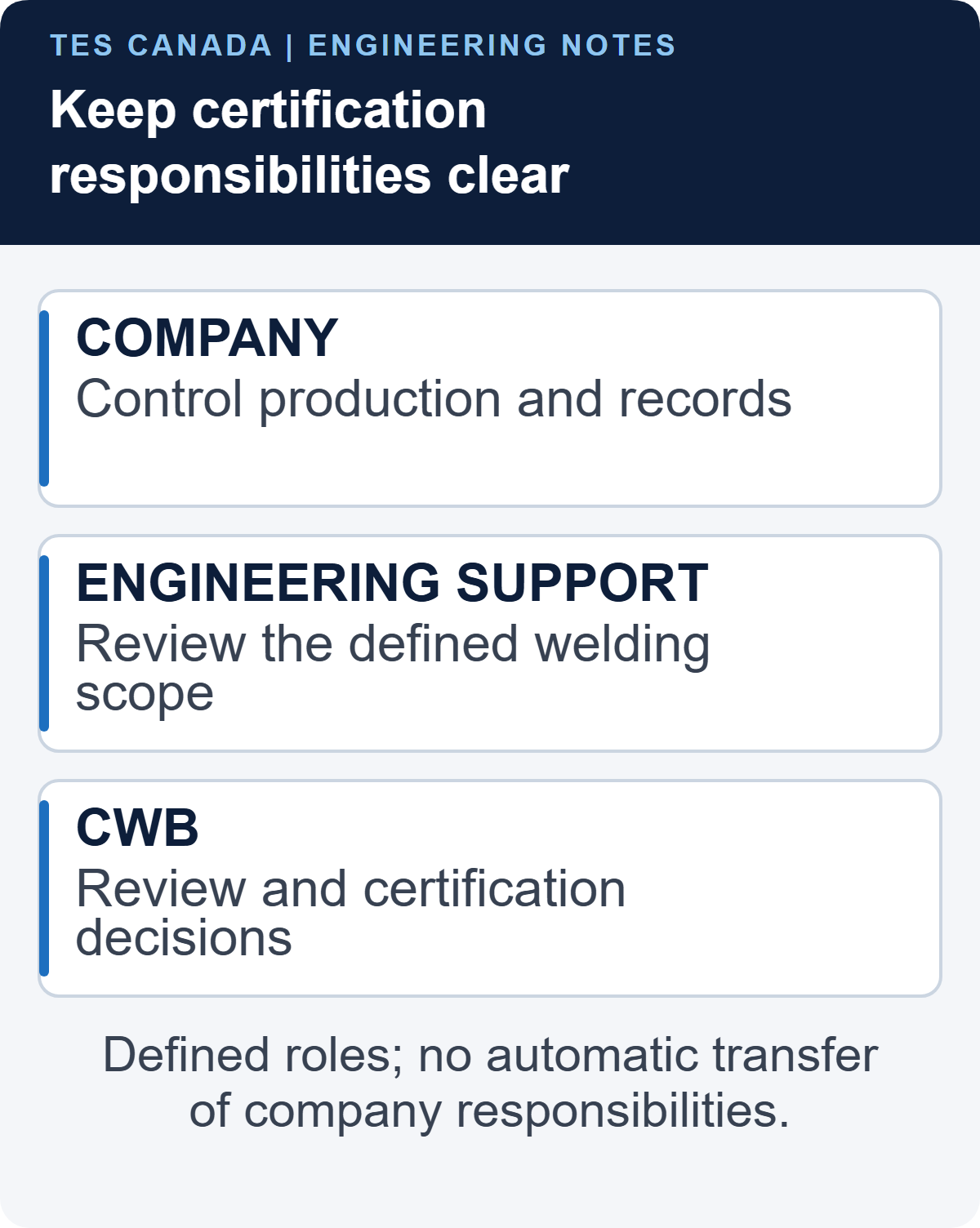
For a fabricator, certification support is most useful when it connects the company’s actual work with clear responsibilities and controlled welding documentation. Employing qualified people, holding procedure documents and maintaining company certification are related activities, but they are not interchangeable.
The practical question is: who is responsible for each decision, and what evidence demonstrates that the arrangements remain appropriate?
Understand the engineering appointment
CWB’s current applicant guide distinguishes full-time employed engineering arrangements for Division 1 and part-time retained arrangements for Division 2. Engineers must satisfy the applicable requirements and CWB acceptance arrangements; professional registration alone does not establish that an individual can fulfil every certification role. [1]
A retained appointment should therefore be treated as a defined technical relationship. The company and engineer need an agreed understanding of the work, information flow and review responsibilities.
Make ongoing support practical
Useful arrangements give the engineer visibility of relevant changes before they become production problems. Examples include new materials, unfamiliar joints, changes in processes and issues raised during fabrication or certification review.
A working review process should establish:
- Which drawings, procedures and supporting records are provided.
- Who identifies changes affecting the welding scope.
- How questions and outstanding actions are recorded.
- How revised documents reach the welding supervisor and production team.
- When additional specialist review or testing needs to be arranged.
These are practical management recommendations. The exact appointment and certification responsibilities remain those established by the applicable requirements.
Distinguish engineering preparation from CWB acceptance
Procedure preparation and submission support do not confer certification authority. CWB reviews submitted welding procedures under the applicable framework; submissions may require revision or qualification before acceptance. [2]
Clear communication helps avoid misunderstandings about whether a document has been prepared, internally reviewed, submitted or accepted. Those stages should remain identifiable in the company’s records.
Review what W47.1:25 changes for the company
CWB’s published transition guidance states that the new edition does not, by itself, require immediate recertification of existing clients or resubmission of all previously accepted WPS/WPDS documentation. The same guidance identifies changes involving robotic welding roles and other defined provisions. [3]
The useful response is a targeted applicability review. Identify the work performed, check the company’s arrangements against the relevant changes and confirm any company-specific actions with CWB. General reassurance about existing documents should not be interpreted as permission to ignore a changed production activity.
Use a focused document review
Start with the company’s certification scope and current correspondence, personnel arrangements, procedures and unresolved review items. Compare them with the work planned for the next period. The result should be a short action register with owners and evidence of completion.
For a fabricator introducing new work, this can be more useful than collecting additional documents without deciding how they will be used.
Key takeaway: Effective certification support keeps engineering responsibilities, company practice and CWB acceptance aligned as the work changes.
TES structural steel welding and CWB certification support includes agreed engineering, documentation and retained-support activities. Certification decisions remain with CWB.
References
- CWB Group — Certification Guide for Applicant Companies, Form 101E/2026-1, engineering and division guidance.
- CWB Group — Welding Procedure Qualification.
- CWB Group — Important Changes in CSA Standard W47.1:25.
Transition information checked 25 October 2026. Confirm current requirements and company-specific directions before implementation.
Related TES Canada Services
Need support with this type of technical challenge?
TES Canada can help you assess the issue, select the right inspection or engineering approach, and develop a practical integrity management solution.
Contact TES Canada →