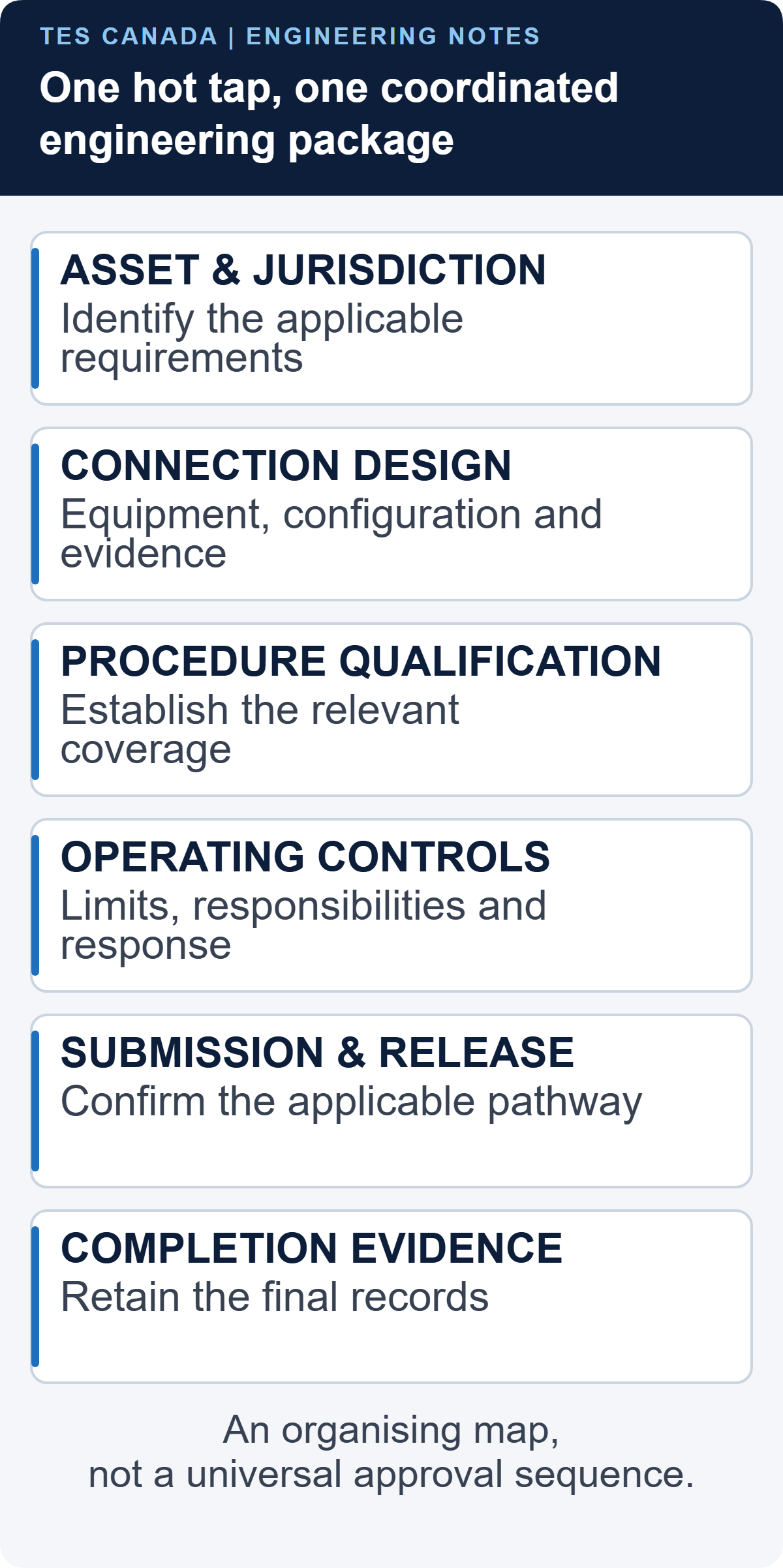
A proposed hot tap may begin as a request for a new branch connection. Turning that request into an executable scope requires more than a welding procedure: the connection design, existing equipment, operating conditions, attachment method, cutting activity and responsible organisations must be considered together.
The first engineering task is to define which asset and jurisdiction are involved. Requirements for Alberta pressure equipment should not be applied automatically to every Canadian pipeline or facility.
Establish the scope and responsible parties
Clarify the intended connection, equipment identification, available records and operating needs. Identify the owner, engineering participants, attachment contractor and organisation performing the cutting activity. Confirm who controls the overall work and who can authorise each stage.
Within its Alberta pressure-equipment scope, AB-513 addresses hot tapping as an alteration and sets out responsibilities and authorisation requirements. Applicable owner-user arrangements must be established for the particular organisation and work; they are not a general exemption. [1]
Build a coordinated document package
AB-381b provides a useful Alberta example of submission requirements. It addresses equipment and design information, identification of the responsible organisation, justification for the hot tap and the documentation supporting implementation. [2]
For project planning, organise the package around connected information:
- Asset identity, design records and local-condition evidence.
- Connection arrangement, materials and relevant engineering evaluation.
- Applicable welding or mechanical-attachment requirements.
- Normal and proposed operating conditions during the work.
- Examination, testing and acceptance arrangements.
- Responsibilities, contingency arrangements and controlled document revisions.
This is an organising framework, not a replacement for the submission checklist or the applicable design rules.
Keep the WPS in its proper role
A WPS and its supporting qualification evidence address the welding procedure within the governing qualification basis. They do not, by themselves, establish the adequacy of the fitting, the remaining carrier wall, the operating envelope or the cutting arrangement.
The engineering review should connect those interfaces and identify missing evidence. It may conclude that a different location, configuration or shutdown-based approach is needed.
Resolve examination and testing interfaces
Define the required examinations, test arrangements and acceptance basis before execution. AB-381b calls for consideration of carrier-pipe collapse when designing the hot-tap procedure. [2] This is a reminder to evaluate the actual configuration and pressure conditions, rather than assuming a fitting’s pressure rating resolves every test-related risk.
Weld acceptance and permission to proceed with cutting are separate decisions. Identify their responsible parties and required evidence in the work package. A procedure document is not, on its own, authorisation to commence either activity.
Plan completion records from the start
Determine the required records and sign-off arrangements before work begins. In Alberta, AB-513 distinguishes completion documentation according to the equipment involved; AB-83a provides guidance for the applicable pressure-piping report. Do not use one form as a universal closeout requirement for all assets. [1,3]
The final dossier should allow the owner to trace what was designed, what was performed, which findings were resolved and what configuration remains in service.
Key takeaway: A defensible hot-tap package connects design, qualification, operating controls, submission requirements and completion evidence around the same defined job.
TES hot-tap and in-service welding engineering support helps owners assess the proposal and prepare the agreed engineering documentation. Field execution, permit coverage and regulatory acceptance are established separately for the work.
References
- ABSA AB-513 — Pressure Equipment Repair and Alteration Requirements, Edition 4, Revision 1 (2023), Section 14.
- ABSA AB-381b, Design Registration Documentation for Hot Tap Procedure Submissions, July 2023, submission requirements.
- ABSA AB-83a, Guide for Completing Form AB-83, Revision 2, March 2025, within its defined pressure-piping scope.
The Alberta example is jurisdiction-specific. Establish the applicable asset, requirements and current submission pathway for each proposed hot tap.
Related TES Canada Services
Need support with this type of technical challenge?
TES Canada can help you assess the issue, select the right inspection or engineering approach, and develop a practical integrity management solution.
Contact TES Canada →