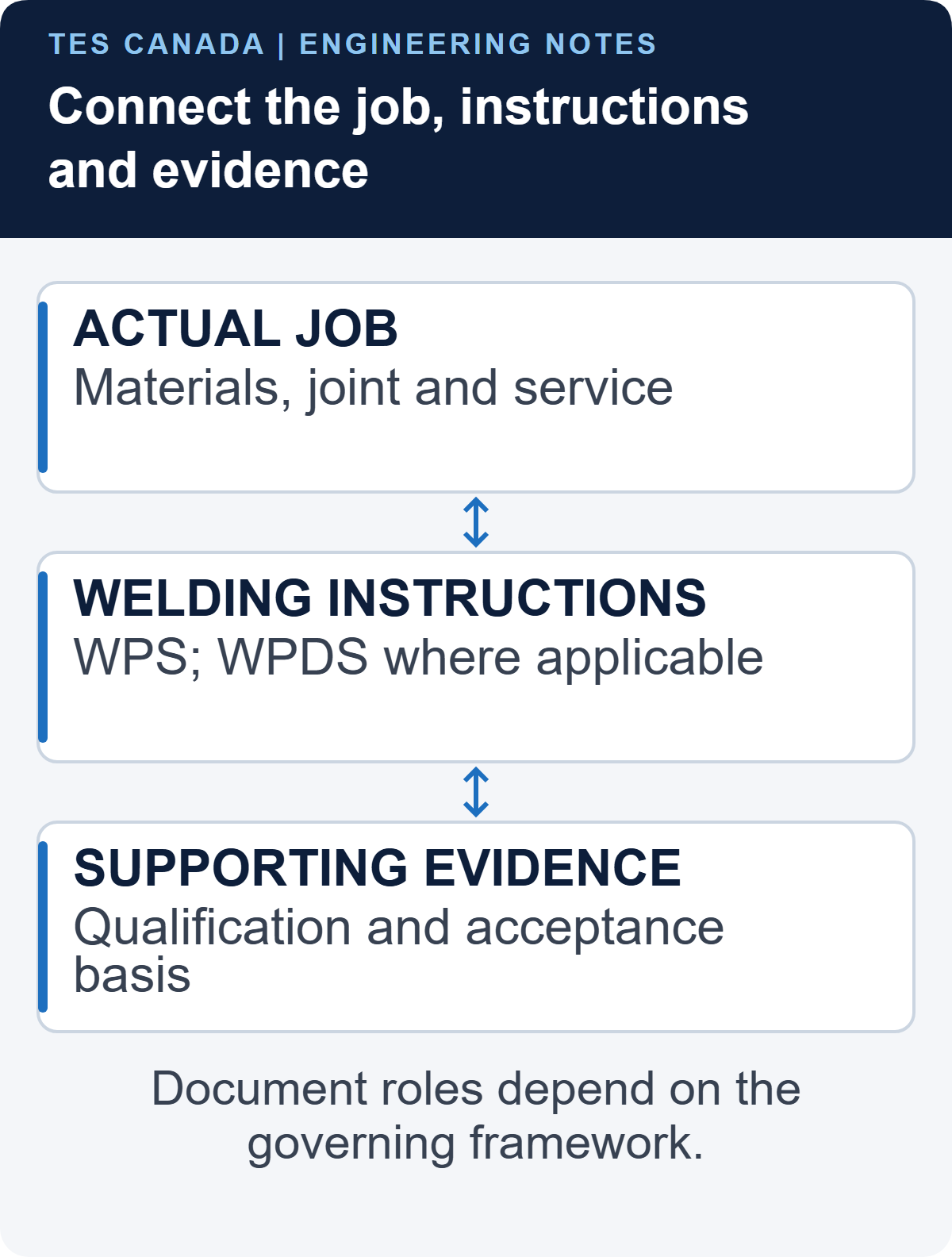
A welding package can look complete while leaving an important question unanswered: does its qualification evidence support the work that will actually be performed? A signed document and a successful test are useful records, but their relationship to the proposed joint still needs to be established.
For an owner or fabricator, the practical objective is a traceable decision: what is covered, what is missing and what must happen before production.
Start with the governing requirements
Identify the asset, construction or repair basis, applicable editions and project specifications. Determine whether service conditions introduce additional requirements. A qualification standard addresses a defined purpose; it does not replace the design basis or automatically resolve every construction, repair or operating requirement.
API RP 577 describes a systematic review of the WPS, the PQR and the relationship between the recorded qualification variables and the production ranges specified in the procedure. This is a useful foundation for a documented review. [1]
Separate the documents and the people
In an ASME Section IX application, the WPS provides welding instructions, while the PQR records the qualification variables and test results supporting the procedure. Procedure qualification and welder or welding-operator qualification address different questions.
Within the applicable CWB framework, the WPS and WPDS have their own documentation and acceptance roles. The WPDS describes the particular joint and welding parameters. A WPDS should not be treated as another name for a PQR, or assumed to follow every ASME documentation convention. [2]
Compare the evidence with the proposed joint
Use the production drawings and material information to review the joint alongside the procedure package. Important questions include:
- Are the base materials, thicknesses and joint configuration identified clearly?
- Do the supporting records justify the specified procedure ranges?
- Are the process, consumables and relevant welding variables addressed?
- Have applicable heat-treatment, toughness and service requirements been considered?
- Are qualification records, test reports and document revisions traceable?
These are review prompts, not a substitute for the essential-variable rules of the governing standard. The required assessment depends on the application.
Turn gaps into actions
Consider a proposed change from one material specification to another. A similar commercial description does not establish that an existing procedure covers the new application. The review should establish the applicable qualification basis, examine the supporting records and identify any further evidence or qualification required.
A useful review report distinguishes an incomplete record from an identified limitation in coverage. It also assigns actions: obtain missing information, clarify the proposed work, revise the instruction or arrange qualification where required. An unresolved gap should remain visible.
Keep the review connected to execution
The reviewed document set needs to reach the people controlling fabrication or field work. Record the accepted revisions, relevant limits and responsibility for addressing changes. Independent review supplements the agreed project controls; it does not transfer every owner, fabricator or acceptance responsibility to the reviewer.
Key takeaway: Review the relationship between the procedure, its supporting evidence and the actual job—not simply whether the documents are present.
TES welding procedure development and independent review can help define the document review, qualification planning and gap-resolution support required.
References
- API RP 577, Welding Processes, Inspection, and Metallurgy, third edition (2020), with the reviewed 2025 errata; Section 6.4 and Annex C. Consult the licensed standard for requirements.
- CWB Group — Welding Procedure Qualification.
Related TES Canada Services
Need support with this type of technical challenge?
TES Canada can help you assess the issue, select the right inspection or engineering approach, and develop a practical integrity management solution.
Contact TES Canada →